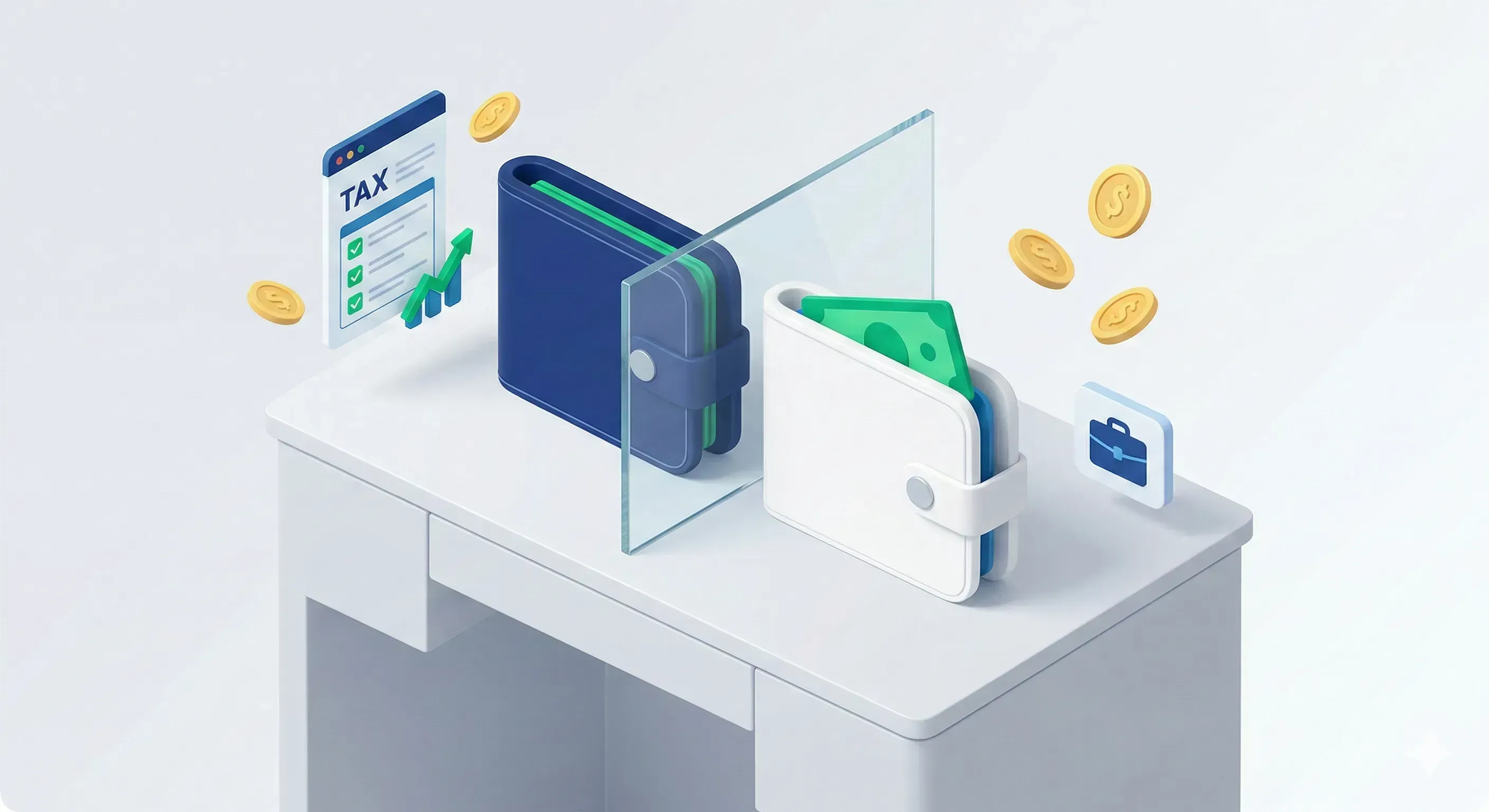
Freelance accounts: Is it mandatory to separate your finances?
💡 Quick Tip
While the law might not strictly require two accounts, your financial health and the tax office do. Discover why mixing grocery money with tax payments is the perfect recipe for chaos. Learn to organize your professional cash flow to avoid audits and tax surprises.
The Single-Pocket Error
Most new freelancers use their personal account for everything. It seems convenient, but it's the main reason freelancers don't know if their business is profitable. Separate accounts are a necessity for legal and fiscal clarity.
Why Separate Accounts?
- Audit Clarity: If audited, the tax office can inspect the account where professional income is received. Mixing in personal shopping gives them full access to your private life.
- Tax Management: Dedicate a sub-account to save 20% for VAT/tax payments. This avoids spending money that actually belongs to the government.
- Professional Image: Paying suppliers from a dedicated business account looks more serious.
- Fast Accounting: Exporting clean data to your accountant saves hours of work and prevents deduction errors.
📊 Practical Example
Imagine you bill $3,000 a month. In a single account, you see $3,000 and think you can spend it. But $520 is VAT and $450 is for income tax. Plus, you have $300 in material costs. Your real profit is $1,730. If you don't separate finances, you might spend $2,000 this month, resulting in a $270 debt to the tax office next quarter. Separating accounts lets you know you only have $1,730 to actually live on.