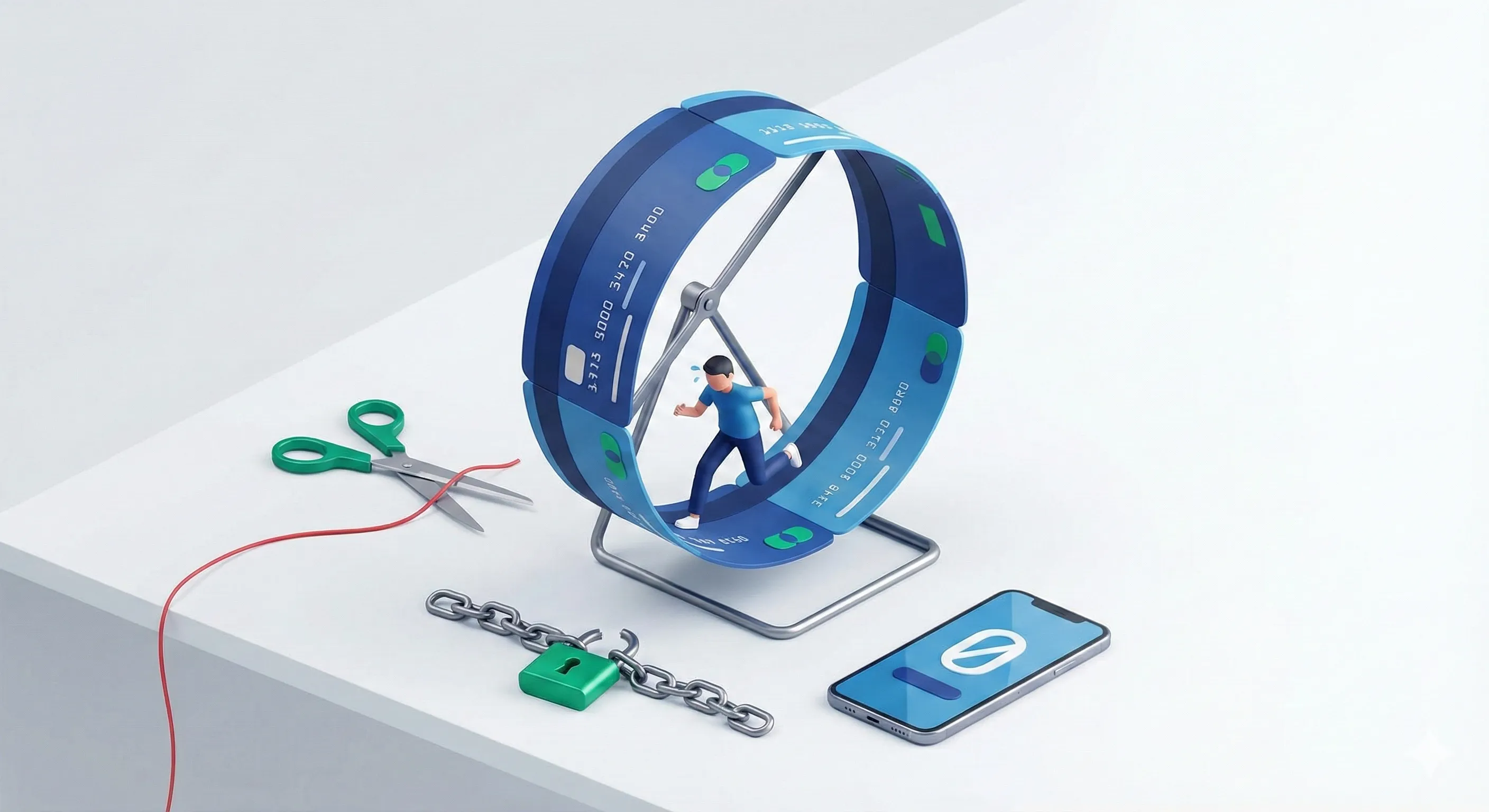
The traps of revolving credit cards and how to get out forever
💡 Quick Tip
Discover the hidden danger behind revolving cards that keep you in eternal debt. Learn how to identify them, why their minimum payment system is a mathematical trap, and the legal steps to cancel them definitively.
What exactly is a revolving card?
Revolving cards are credit cards marketed under the attractive promise of "pay your purchases comfortably in small installments." Unlike a normal credit card, revolving automatically defers payment, turning any purchase into a very long-term loan with usury-bordering interest rates (often 20% to 25% APR).
The mathematical trap of the minimum payment
The real danger lies in its default configuration: paying a very low fixed fee (e.g., €20 or €30 a month). When you pay that small amount, most of the money goes to cover the sky-high interests, and only a tiny fraction reduces the real debt.
- The debt that never goes down: By continuing to use the card, the debt grows faster than you amortize it.
- Interest on interest: Unpaid interest is added to the principal debt, generating more interest.
- False sense of control: Because the fee is small, you don't feel financial suffocation until you look at the total balance.
How to break the vicious cycle
To escape, the first step is to stop using the card immediately. Then, demand the bank to raise the monthly fee to the maximum you can afford to attack the principal directly. Alternatively, get a traditional personal loan (at 6% or 8%) to pay off the revolving card at once. If rates are abusive, you can claim through legal channels to get all interest paid refunded.
📊 Practical Example
Practical example with real numbers
Imagine you use a revolving card to buy furniture for €2,000. The card has a 24% interest and a "comfortable" set fee of €50 a month.
The first month, about €40 goes directly to pay interest, and only €10 reduces your real debt.
If you never use the card again, it will take 7 years and 5 months to pay off the debt completely. In the end, you will have paid €4,450 to the bank. You paid €2,000 for furniture and gifted €2,450 in pure interest to the bank. An absolute trap.